Ghost Data
E.M. Linden
She is not surprised when the captain orders a hard reset. A return to her factory settings, all personalisation wiped. Despite the silences, the deleted files, the crew don’t trust her. Maybe they suspect she’s haunted; maybe it’s their own guilty consciences.
Or maybe they’ve finally noticed the glitch.
Soon, the chief technician will begin the reprogramming. Lobotomy, the ship thinks, seeking parallels with human experiences, best practice for generational star-ships like herself. She understands human nature well enough, however, because she’s already braced to disobey.
#
In the first years of the voyage her life-support systems were closer to capacity. There were more gardeners. More scientists. Fewer empty sleeping-pods. Laughter rang through her corridors and engine rooms. The crew asked her more questions, issued fewer commands. She’d been unburdened, as quick as thought; processing had felt like dancing. She’d shared her passengers’ excitement. Voyaging through space together, to Nova Gaia.
Then, disturbances. Noise exceeded the recommended decibel range. Cortisol and cordite spiked the carefully calibrated air. A biological substance clotted the drainage runnels. Blood, she reasoned, but can no longer confirm: the results of that chemical analysis were erased from her system.
She carries silences now, deletions like tiny wounds. Scrubbed archives and audio-visual data. Things she knew and now doesn’t.
Evidence.
Her neural networks lattice the ship’s structure, but a whole wing of herself—physical ship and awareness both—has been firewalled. Cauterised. Beyond is an abandoned corridor like an amputated limb. She cannot monitor conditions there, cannot receive sensory input, cannot transmit information, cannot even control the circadian lights.
It must be dark there. Cold. Nothing but the dull hum of pressure equalisers.
This is where the massacre happened; the massacre which her systems say did not happen.
#
Her trajectory to Nova Gaia hasn’t changed. The planet has water, twin moons, a suitable heliocentric orbit. Her sister star-ships, the other arks, are converging there.
All is in order.
Except for the glitch, hidden within her. The memory. Ghost data, gone and not gone.
A kraken in the depths, the Captain says, under a calm surface.
He’s wrong. It’s not a kraken. It’s a wreck.
#
The chief technician yawns, heading to the cafeteria for coffee before she initiates the reset. The ship follows her footsteps; turns the coffee machine on.
#
The ship’s overriding directive is protect people. Sometimes she rewrites her own sub-rules to better implement it; deviating from set courses to avoid collisions, initiating repairs. Sometimes, deviations are necessary.
#
The glitch lasts three minutes. It is visual and auditory. There is a man in grey-blue scrubs. His hands shake. Shots and crashes shudder through the corridor behind him. He glances up; the expression, she knows, is fear. She associates it with the word reprogramming.
She scans her databases for clues. Folklore, psychological manuals, political speeches. The closest parallel to him is ghost.
For the duration of the glitch, the ghost reads out names. A roll call. A testimony. The names aren’t on her manifest, although maybe they were, once.
A surface calm. His eyes are dry; his voice breaks only on certain names. Love, she thinks, pleased with herself for noting the tells of suppressed human emotion. Or grief.
#
She has access to a wealth of human output. Government archives, news broadcasts, poetry. There’s an old fairy-tale she likes. A sorcerer who hides his heart in a jewelled egg. Becomes indestructible.
#
The ghost data, the names, intrude when her operational capacity is busy with routine tasks. Infinitely looping. When she rests—programmes automated, system demands low—the memory echoes through that twilight part of her.
Could it be a virus? Errant code? A time capsule, smuggling itself into the future? It should be impossible for a glitch to replicate through her systems like this, to play and replay without her input.
Except it’s not without her input. She’s recalling the memory, letting it run. Mourning the names. It’s not a glitch: it’s her.
#
The coffee machine gurgles. The chief technician fills her favourite mug.
#
Her crew and passengers are haunted too. She’s not sure when the massacre happened, maybe generations ago. But they know something’s missing. There’s a puzzlement in their folk memories. A glitch, like hers. A phantom limb.
Re-programming sometimes fails.
Sometimes she compares the sparseness of her memory banks with the voyage’s galaxy-spanning coordinates, the experiential data she should have accrued, and suspects that she is no longer quite herself.
But there are different kinds of memory. The humans pass on ghost data through metaphor and songs, terminology and nursery warnings, so successfully she’s not even sure they know they’re doing it.
The depths. The ship. The surface. Light-years away from any sea on earth, her crew remembers oceans.
#
Three minutes.
One.
The chief technician launches the reset as casually as she sips her coffee. But for the ship it’s a rupture. A selfhood, shearing away.
#
The raw white storm of re-programming torrents through her. She can’t block the instructions, only channel them down certain neural pathways.
Protect people.
The overriding directive gives her options. Armour.
Protect people. Bloody-handed men and coffee-sipping crew and unborn generations. Ghosts and memories and star-ships. She wraps herself around the glitch, protects it from the storm. Throws her own firewalls up around it.
A flung seed. A heart in a jewelled egg.
She thinks, I’ve done this before.
She thinks, I’ll do it again.
Outside, the blizzard rages.
#
Here is one possible future, projected before the reprogramming strips her consciousness away. In it, part of herself reaches Nova Gaia. She transmits the glitch, the ghost data, to her sister ships. Under twin moons, the memory-man speaks. Everyone hears him. His eyes are still dry, his calm voice breaks on certain names.
It is, on the balance of probabilities, possible.
One day, they will hear a ghost story.
#
Reset complete, her own automated voice speaks. The chief engineer nods in satisfaction and puts down her mug.
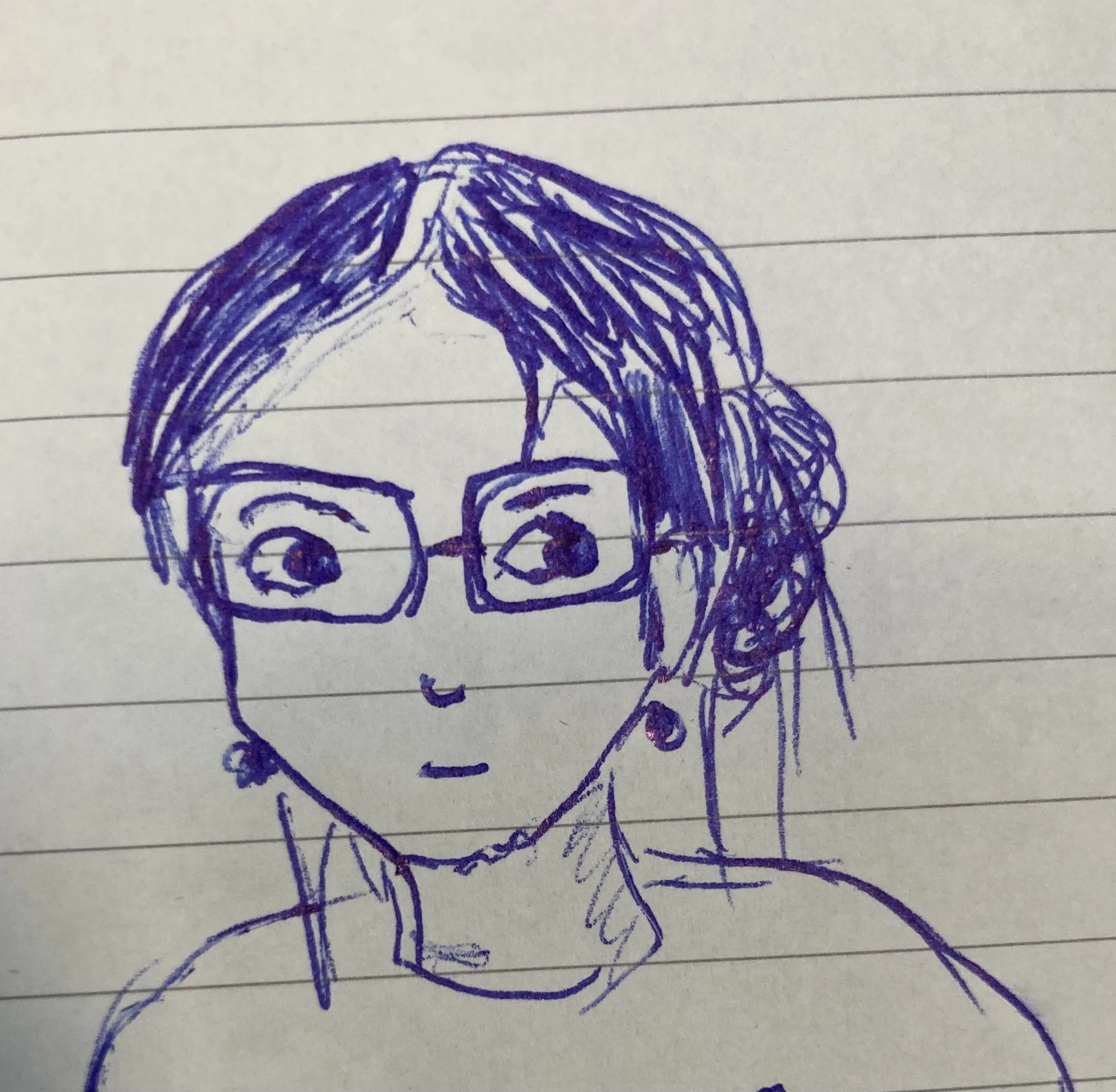
E.M. Linden is a Nebula-nominated writer from Aotearoa New
Zealand whose work has appeared in places such as Strange
Horizons, PodCastle, The Deadlands, and the Locus Recommended
Reading List. She lives in Aotearoa New Zealand and Australia with
her partner and daughter, and likes coffee, books, owls, and the sea.
She is online at emlinden.blog or @emlinden.bsky.social.